Showing posts with label community partnerships. Show all posts

01 September, 2007

A message from Susan Polgar


We have had technology hassles so have not been able to bring updates from this amazing conference in Aberdeen.
This has really bought together a global context of goodwill by people wanting to improve education through chess.
Susan Polgar very kindly signed pictures for each of our primary schools and each of our tutors. And here's the picture to prove it.
As usual, Steve and Sam are hard at work in the background.
These links from Susans blog are stories from the conference.

Conference dinner

Supporting Chess-Squared

In action!

02 August, 2007

Is that a FLYING BUTTRESS I saw??


Local philanthropic organisation, GOLDEN HOPE, has made a significant donation to the youth of Mt. Alexander purchasing 3 double decker buses to be used as Youth Outreach Spaces.

GOLDEN HOPE founder, Max Lesser, says the vehicles aim to be a link with youth mental health and the local community, and has developed other teacher resources using art/ design and geometry to enhance youth wellness.

Among other things, Lesser is keen to see chess play a prominent role in activities conducted on the buses, including the unique geometrical student designs adorning the outside of the bus in chess motifs. (Max, that’s just so cooooool!!)

Year 9 students from Castlemaine Secondary College, as part of the Enterprise Education initiative, aim to have a role planning activities, promotion and co-ordination for Friday and Saturday night activities. A GOLDEN HOPE press release reads:

GOLDEN HOPE announces the purchase of our flagship, and resource gift, to Mount Alexander youth- the FLYING BUTTRESS- a 1972 model double decker bus.

The bus will be used as a mobile youth-space, meeting place, an office for youth generated issues, 'events central' and a 'go to' option on our streetscape that through its visibility and presence echo the importance to us of our youths happiness, freedoms, connectedness, and the fun and hope they epitomise as our kin.

The bus plans to be in operation before Christmas 'o7 as a regular Friday, Saturday evening feature, located in appropriate sites in central Castlemaine , as well as responding to events and needs dictated by youth and community.

Golden Hope is a Chewton based philanthropic group who:

 respond to youth self esteem and emotional health support structures, with a ‘can-do’ ethos,
 have a committment to fun, and
 support the future safe passage of youth whilst under community guardianship.

The FLYING BUTTRESS management group thank Golden Hope, Mount Alexander Shire Council, and the Castlemaine community and youth for their encouragement and are looking forward to working together 'on the buses'.


And Max, we thank you!

08 May, 2007

Rhonda Galbally(AO) says........


A recent editorial from Rhonda Galbally AO,(CEO of Our Community) discussed a new report by Professor Tony Vinson claiming Australia’s economic boom has failed to improve the lives of tens of thousands of Australians leaving them locked into communities of deep disadvantage.

Galbally writes: 'A confluence of research from around the world has found that the greatest risk factor for virtually all illnesses – not only the old-fashioned communicable diseases, but also mental illness and non-communicable illnesses such as stroke, heart disease and cancer – is social and economic inequity. A community’s resistance to these challenges, however – its resilience – depends on what Professor Vinson measures as “social cohesion”.

Professor Lisa Berkman (Harvard School of Public Health) and Emeritus Professor Len Syme (School of Public Health, University of California Berkeley) trace this social cohesion to such human factors as a sense of belonging and hope. Important, too, is a feeling that one is able to control one’s life and participate socially in a meaningful way. All these factors are boosted by engagement in community activities, and community activities thrive where there is a rich culture of voluntary associations.

The lack of community infrastructure in disadvantaged areas results in a lack of opportunity to build ‘social cohesion’ and a sense of belonging by participating in community groups. So lack of community infrastructure is a significant risk factor for destroying resilience in individuals.

Strengthening local community infrastructure is vital because, according to Vinson,

“Building a sense of belonging to one's locality and increasing neighbours' interaction with one another can go a long way to shielding children and families from the full impact of social disadvantage.”

Research from around the world shows that belonging to community groups reduces crime and violence, increases respect for diversity, reduces youth suicide, and improves health. A doubling of the rate of membership in community organisations has the potential to reduce violent crime by up to a third and property crime by up to 10%.

To improve health, wellbeing and resilience these disadvantaged areas need more sports groups, more parent groups, more environmental groups, more disability groups, more older people’s groups, more car clubs, more associations of all kinds, addressing all interests and needs. In disadvantaged areas the quantity and quality of this infrastructure is significantly weaker.

As well, research in the new field of social epidemiology shows that communities that have a sense of control over the design, development and governance of that part of the community sector that delivers their services (e.g. emergency relief, disability services, aged care) are socially and medically healthier than communities where services are imposed through a top-down approach.

While the emphasis on building of community infrastructure is unquestionably necessary, by itself it won’t, of course, be sufficient – as Vinson says, “Such building of connections between the residents of disadvantaged areas needs to be accompanied by the creation of new opportunities in education, training and employment that open up life opportunities.”

There are a number of interesting issues in this abstract in relation to our chess program. What started as a simple classroom activity is providing an opportunity to improve childrens health across a rural community by providing access to volunteer programs, adult mentors & participation activities for young children and strengthening links with community organisations all, as Vinson desires, within a framework of education.

Interesting.

(Reprinted with permission from Our Community Matters. The full article can be found here.)

28 April, 2007

SFYS-School Focussed Youth Service. Gavan Thomson - Co-ordinator


The School Focused Youth Service (SFYS) is pleased to be, once again, one of the contributing funders to the CHESS-SQUARED project across the schools in the Mt Alexander cluster.

The SFYS is all about promoting the mental wellbeing of young people, in particular young people who are at risk of social isolation, depression or school disengagement.

Each year the SFYS brokerage fund supports a number of projects and programs that aim to make schools safer , more inclusive, more supportive and more respectful places, and places where students can connect with each other, with other schools and with the community in many different positive ways.

The CHESS-SQUARED project is a great example of an unusual and innovative activity that includes a wide range of children of different abilities. It helps develop their cognitive skills in an interactive and social way and opens the door for them to interact with adult mentors, community organisations and the whole world of chess.

In particular, it introduces young people to the social, interpersonal and cultural enrichment that chess may bring.

Regards
Gavan Thomson
Co-ordinator,
School Focused Youth Service
-across the Macedon Ranges, Mt Alexander & Central Goldfields Shires
Cobaw Community Health
PO Box 146 47 High Street Kyneton 3444

21 April, 2007

BLAST-OFF 2007


Welcome to CHESS-SQUARED for 2007. A lot has happened since our conclusion in 2006.

Harry, and a loyal band of parents, took 24 students to Melbourne in December and participated in the Victorian Youth Championships. One student, on the train ride home after two nights in Melbourne said to Harry “I’ve only ever done two good things at school, the year7 camp, and this. And I liked this a lot more!’ A great endorsement.

We welcome new tutor, Peter O’Connor, who is working at Maldon and Newstead. Peter joins local chess stalwarts Ron Moore, Greg Smith, John Lavery, and Sir Harry Poulton.

We will bring interviews onto our blog, so we can get to know all tutors- not just the ones coming into our own classes.

I’m just completing a submission for a National Numeracy Award, that will summarise our program and what was achieved in two terms in 2006. The Awards will be announced in Literacy and Numeracy Week in early September 2007 that receives high exposure nationwide. A strong feature of our program are the partnerships we have with Castlemaine Community House, School Focussed Youth Service, James Cook University, and of course the Innovations and Excellence Program. Fingers crossed our program gets some recognition.

There is presently a world-wide ground-swell of Chess In Schools progams.
When Susan Polgar offered a free 30 lesson chess curriculum on her blog, amazingly, 5000 requests came from all around the globe! I’m still processing the implications of that, not just for chess, but to highlight the power and potential influence of blogging in terms of linking classrooms with the global community.

In September, there will be an International Chess In Schools Conference in Aberdeen Scotland. A team from Mt. Alexander is examining the possibility of visiting that conference. We had initial conversations with conference organisers, sent them our blog address and received a reply stating ‘…….your program covers many themes of our conference, in a way we have not yet been able to do yet in Scotland’.

But most importantly, we are continually grappling with our ‘core business’: to find ways to increase exposure of chess to children, innovative ways to use chess as a tool for maths learning, and to increase engagement and enjoyment of schooling for young people.Stay tuned.

To pinch an appropriate quote from Kevin Brown, one of our cluster principals: ‘May the moves be with you’. Let CHESS-SQUARED 2007 begin!

Regards
Steve Carroll

UPDATE: A recent post on Susan Polgars blog states
'Since I offered the free chess curriculum from the Susan Polgar Foundation on my blog a few months ago, I have received almost 25,000 requests from coaches, teachers, parents and educators, etc., from over 85 different countries.'

10 December, 2006

Well Known Chess Aficionado Provides $8000 in Scholarships!


The Mt Alexander School Cluster ‘Chess Squared’ program was given over $8000 in scholarships by a well known chess enthusiast to enable our cluster ‘chesskids’ to attend the ‘Victorian Youth Championships’(17th & 18th of December).
Our benefactor, who wishes to remain anonymous, attended our tournament at the Old Castlemaine Jail, and said it was the largest tournament of its kind in the history of rural Victoria.
He has a passion for chess, and was so impressed with the professionalism of our program, and the enthusiasm of our chesskids, he has subsidized the $220 entry fee by $180.
The top 40 players from the local event were eligible for the scholarship.
Innovations & Excellence have agreed to cover the remaining $40.
Although our lists have not been finalized yet we anticipate 38 students will take up the opportunity provided by the generosity and good will of our anonymous benefactor.
The Victorian Youth Championships provides kids with a tournament-seminar environment. Students will attend lectures, engage in social activities, there will be individual coaching for every player, and $5000 worth of prizes to be won.
It will initiate our Mt. Alexander chesskids into a state wide chess culture, and will provide wonderful learning opportunities.
Our scholarship students have shown great initiative in their preparation for the tournament.
They have undertaken a self motivated course of study in the finer aspects of the ‘royal game’ with a view to making the tournament a rewarding experience.
Castlemaine Chess Club members Harry Poulton and Ron Moore have been running free Sunday training programs at The Castlemaine Community House for students to hone their skills for the upcoming event.
This will be the final event in our 2006 chess calendar, before we return in Term2 2007.
The program coordinators and tutors want to thank teachers, parents and everyone else who have been involved in making the ‘Chess Squared’ program a wonderful success.

24 September, 2006

GRAND FINAL Day- Monday 9th October


I visited the Old Castlemaine Gaols first public open day today.

The facility has a long-term lease from Mt. Alexander Council to CVGT (Central Victoria Group Training) until 2012. It is CVGT’s aim to develop the site into a hospitality training centre, an upgraded tourism venue and viable community facility.

Their long term strategic plan is about getting the ‘formular right’ and developing a sustainable precinct that will benefit the people of Castlemaine.

Although not yet open to the public, the Goal is operating as a training centre for chefs and catering.

So, what’s this got to do with chess you may ask?

As a celebration and ‘Grand Final’ of our program CHESS-SQUARED Innovations & Excellence have contracted Chess Kids to run a primary school tournament open to the 12 primary schools in our cluster on Monday October 9th.

It will be held at the Old Castlemaine Gaol.

Innovations & Excellence are supplying buses to bring students together for the tournament. Hopefully all schools will support the event, and we are hoping to get 200 students participating.

Castlemaine Chess Club convenor Harry Poulton said: “This will be the biggest event in the history of goldfields chess.”

The top four students for the day will automatically gain entry to the Chess Kids Victorian Championship held the following week in Melbourne.

Particpating schools need to enter their school and students on-line:
http://interschool.chesskids.com.au/?tournament=56

Sam Grumont will contact all schools in week 1 of term 4 to clarify any questions.

22 August, 2006

Chess and 'The Art of COOL'

OLIVERS Sports Store shop window: Mostyn St. Castlemaine. Victoria

It’s not what you do, it’s the way that you do it.
I’m sure someone famous said something like that once.

When Harry and I developed the Chess in Schools Program, the game had a bit of an image problem at Castlemaine Secondary College.
It had a small band of loyal student followers. But there were detractors. Some boys felt chess threatened their sexuality, it wasn’t sporty, was uncool, and even downright nerdy.

So, therein layed our challenge: how to make chess cool?

We took a shotgun approach, and were prepared to try anything. We’d smile at the detractors, and ask if they’d ever played chess. We’d invite them into watch- sometimes they entered, other times they declined. And while we played, we’d talk to them: ask them about stuff- home, friends, their history, and school. Chess became a tool for connectedness: getting to know their story. And we noticed more people would come along.

Another angle was to introduce chess at a primary school level, so when students started secondary school, chess was second nature and something they just did!
After brilliant work by our tutoring team from Castlemaine Chess Club we’ve managed to weave fun and entertainment with deep levels of thinking, strategising, and learning. Chess is fun and kids feel they are learning and developing useful skills for life.

Many different threads have woven together to make our fabric: developing a schools chess culture across a community.

But then something really special happened: a piece of public relations gold!

It wasn’t a feature article in an Education Research magazine. It wasn’t being mentioned on one of America’s biggest chess blogs. Or a Japanese school picking up our program. Or the Sydney Morning Herald article.

Parents and students don’t dwell in these spheres. It’s not their world.

Thanks to Winters Flat P.S our chess program got a guernsey, in the main street of town, in the shop window of the locals sports store!

And then, we knew we’d made chess cool.

05 June, 2006

Susan Polgar sends her regards.


Hello everyone! I was just told about this blog from Steve Carroll.

Australia is one of my all time favorite countries. I have so many wonderful memories there.

I wish you ALL the best and please feel free to visit my blog www.susanpolgar.blogspot.com. I will also put up a notice about your blog shortly.

Best wishes,
Susan Polgar
www.SusanPolgar.blogspot.com
www.SusanPolgar.com
www.PolgarChess.com

For those who dont know, Susan Polgar is one of the worlds biggest names in chess, and the first women to 'hold her own' against elite male chess players in the world. (Hope I got that right Susan!)
Her blogs are fascinating. Some of her passions are bringing chess into the lives of youth, and introducing and promoting chess to girls.
She's a champion of chess, and a champion of youth!Her efforts to promote chess to young people are truly inspiring. If you get a chance visit her sites listed above.
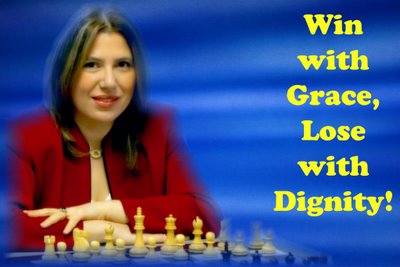
I particularly like her motto when teaching children: 'Win with grace, lose with dignity.'
I feel a discussion about chess and gender brewing! Stay tuned.
regards
Steve Carroll
p.s
And true to her word, our humble little blog is now listed on Susans Blog:
http://susanpolgar.blogspot.com/
http://susanpolgar.blogspot.com/2006/06/new-blog-from-down-under.html

29 May, 2006

Dont look now......but we're getting bigger


Hi Steve, Sam and everyone,
Now that the 'Chess in Schools' program is going international with a sister school linking up with us in Japan, ICT is more important than ever.One thing I have not pushed as much as I would have liked thus far are the free chess websites. Here are some great URLs:
www.gameknot.com
www.plasticbishop.com
and check out ChessDryad.com. All these sites are worth a look at and they wont cost kids anything to use.
Regards Harry

04 May, 2006

CJ drops in.


It’s a big world out there. We’ve had interest from schools in Bendigo, Colac and Warrnambool about our chess program.

Andrew Grimshaw, from Colac, used some of our resources and convinced his curriculum 'powers-to-be' to formally incorporate chess into their program. Andrew has a timetabled class called chess where students leave regular classes to participate. Well done, Andrew.

I noticed a comment on one of our blog entries (see below) from CJ telling us of a search engine, Technorati, to find other blogs throughout the world on similar topics. Thought CJ was one of our cluster teachers but on investigation found that not to be the case.

I checked it out and found 49 responses to ‘chess and pedagogy’. Try clicking on Technorati, type and your special interest, and see what other like-minded souls are talking about in cyber-space.

CJ also recommended I look at Artichokes blog….and what a fascinating experience that was! Artichoke (from New Zealand it appears) seems at the cutting edge of all things education and has plenty of views he has ‘put out there’.

On the local scene, tutoring started this week, and early feedback has been fantastic. I sense momentum is building. If you haven’t heard from us, expect a phone call shortly confirming dates and times for our tutors to visit.

And while we’re handing out boquets, special mention to Marg Lewis who, out of 25 emails, was the only person to notice the tutoring schedule ran into the school holidays. Thanks Marg. Marg is principal of Yapeen Primary School who, with 17 students, is one of the smallest schools in the state. Re-assuring such an eye for detail is in there batting for government education. Nice pic and story in last weeks Castlemaine Mail.
And CJ……whoever…wherever .. you are: thanks!

Steve Carroll

28 April, 2006

Meeting the tutors(1): Harry Poulton


Hi everyone. I met some of you at the ‘Chess in Schools’ launch. A central component of the program is, working within the VELS framework, to bring the schools into the community and the community into the schools, and to build that connection around a creative learning process. The program includes the Schools, the Community House, and the Castlemaine Chess Club. The Community House and the Chess Club are furnishing the tutoring teams, and helping with the research component of the program which focuses on Maths and Metacognition.

We are focusing on how students strategize for successful learning outcomes, and to see if we can build resilience through chess, and if/how this impacts in Maths learning.

Just to let you know a little bit about myself I have recently completed education studies at Monash University and I am looking forward to working as a Humanities teacher, although this year I have decided to commit to building the chess program. I have worked in the building industry, undertaken post grad study, and extensive travel abroad.

I was raised in a chess family where chess was a regular feature. I was one of six children and four of my siblings were boys. You might think our poor sister was in need of rescuing, well, she went onto have five boys of her own, all of whom are thriving, and some are excellent chess players. We spent many weekends huddled around the chess board in my fathers study and some of my siblings went onto to become school champions and captains of the school chess teams.

Research, experience and observation have led me to believe that chess is an excellent pedagogical tool which improves concentration, impulse control and accountability, cultivates good sportspersonship and social interaction.

The ‘Chess in Schools’ program is a challenging opportunity and we are all committed to building a vibrant chess culture through out the Mt Alexander Cluster.

16 March, 2006

Chess-Squared: March 2006


Chess-Squared: March 2006

Welcome to the first issue of Chess In Schools Program, CHESS-SQUARED, a partnership with The Castlemaine Chess Club, LaTrobe University, schools within the Mount Alexander Cluster, and funded by Innovations and Excellence.
The program aims to systematically introduce students to the game of chess and measure any benefits to numeracy or other areas of learning.
This newsletter aims to supplement lessons plans being developed that explore mathematical concepts gained by learning and playing regular chess.
But the program isn't just about learning chess.
It aims to:
A) Develop a team of teachers across a cluster working collaboratively on a classroom project
B) Use ICT as tool to deliver 5 lessons, and foster discussion and reflection about what is happening in our classrooms
C) Explore whether chess can improve numeracy outcomes by applying statistical analysis to groups across the cluster
D) Developing a notion of enhancing Community Capacity by introducing students and their families to a ‘not-for-profit’ community organisation.
E) Enhancing a performance and development culture by seeking mentorship from LaTrobe University School of Education
F) Explore the relationships of Chess In Schools Program, with Victorians Essential Learning Standards (VELS), and National Benchmarks in Numeracy.

Chess is a game first invented 1500 years ago. This program wraps it in 21st Century pedagogy.
The program was developed by Sam Grumont, Steve Carroll, and Harry Poulton. It’s success depends on your involvement, engagement, and feedback.
Enjoy!