29 May, 2007

Meeting the tutors(3): Greg Smith


My name is Greg Smith and I’m a chess tutor. Thanks Harry and Steve for asking me to join the team.

Unlike Harry I came late to Chess. I played a few games as a child and luckily remembered the moves when I first attended the Castlemaine Chess Club. There I enjoyed the company, wisdom, humour and coaching of the astute.

I became a father in 2002 (I now have a boy and a girl) and a teacher in 2003. I had taught SOSE, ICT and Art, previously to tackling Chess. The student’s enthusiasm and engagement with chess overwhelmed me. Truly amazing! Chess works.

I distinctly remember a point when 30 children all pondered studiously silent, each brain computing at the speed of light. This despite my preferred method of encouraging banter, conversation and discussion. I have derived happiness reaffirming that children enjoy thinking.

I have been privileged to attend 5 schools in Mt Alexander Shire and I enjoy the diverse challenges available. All teachers have been warm and supportive and speak of positive results. Large, small and mixed age classes all require different approaches. I am often asked about gender bias and I haven’t observed any. Students love to count up the pieces. Whether it is shown that chess improves maths or not I remain convinced that chess in schools, particularly at upper Primary level, is eminently beneficial.

Harry sums up chess so perfectly I will simply quote him here.
“Research, experience and observation have led me to believe that chess is an excellent pedagogical tool which improves concentration, impulse control and accountability, cultivates good sportspersonship and social interaction.”

With chess, a novice can play an experienced player, beautifully expressed by an Indian proverb, "Chess is a lake in which a gnat may sip and an elephant may bathe."

(Meet our other tutors here and here- scroll down a bit!

20 May, 2007

Dancing with Data- Part 1


The graph above of Pat Maths results across the cluster provides a snapshot of what has happened with numeracy Mt. Alexander schools in 2005 and 2006. It is difficult to draw conclusions from the line graph.


But when we combine stanines into low(1+2+3), medium(4+5+6), and high (7+8+9), and plot a column graph clearer and interesting trends begin to emerge.


So, what can we say?
It appears there has been some improvement in numeracy across the cluster. Although, we have to be careful here. We’re comparing two different groups, and there are no isolated or control variables. On their own we can’t be too confident of these results meaning anything definate.
Harry and I have enrolled in the Graduate Certificate for Educational Research Methods and are understanding the fascinating complexities of educational research- a unique blend of scientific(quantitative) and humanistic(qualitative) approaches.
But, here is the strength of the humanistic approach: these graphs have ‘shone a torch’ on an area for further investigation.
By conducting interviews, compiling vignettes, recording teacher observation, parent comments, & tutor observations we might begin to draw a picture about what specifically in our program is happening with student learning. It’s often through qualitative approaches we find the unexpected, discover both subtleties and complexitites within education.
And from that, ascertain what contribution regular chess playing has on learning outcomes.
The moral to the story: its not always the graph that tells us entirely what’s happening, but understanding what’s happening in classrooms that gave us the graph in the first place.

08 May, 2007

Rhonda Galbally(AO) says........


A recent editorial from Rhonda Galbally AO,(CEO of Our Community) discussed a new report by Professor Tony Vinson claiming Australia’s economic boom has failed to improve the lives of tens of thousands of Australians leaving them locked into communities of deep disadvantage.

Galbally writes: 'A confluence of research from around the world has found that the greatest risk factor for virtually all illnesses – not only the old-fashioned communicable diseases, but also mental illness and non-communicable illnesses such as stroke, heart disease and cancer – is social and economic inequity. A community’s resistance to these challenges, however – its resilience – depends on what Professor Vinson measures as “social cohesion”.

Professor Lisa Berkman (Harvard School of Public Health) and Emeritus Professor Len Syme (School of Public Health, University of California Berkeley) trace this social cohesion to such human factors as a sense of belonging and hope. Important, too, is a feeling that one is able to control one’s life and participate socially in a meaningful way. All these factors are boosted by engagement in community activities, and community activities thrive where there is a rich culture of voluntary associations.

The lack of community infrastructure in disadvantaged areas results in a lack of opportunity to build ‘social cohesion’ and a sense of belonging by participating in community groups. So lack of community infrastructure is a significant risk factor for destroying resilience in individuals.

Strengthening local community infrastructure is vital because, according to Vinson,

“Building a sense of belonging to one's locality and increasing neighbours' interaction with one another can go a long way to shielding children and families from the full impact of social disadvantage.”

Research from around the world shows that belonging to community groups reduces crime and violence, increases respect for diversity, reduces youth suicide, and improves health. A doubling of the rate of membership in community organisations has the potential to reduce violent crime by up to a third and property crime by up to 10%.

To improve health, wellbeing and resilience these disadvantaged areas need more sports groups, more parent groups, more environmental groups, more disability groups, more older people’s groups, more car clubs, more associations of all kinds, addressing all interests and needs. In disadvantaged areas the quantity and quality of this infrastructure is significantly weaker.

As well, research in the new field of social epidemiology shows that communities that have a sense of control over the design, development and governance of that part of the community sector that delivers their services (e.g. emergency relief, disability services, aged care) are socially and medically healthier than communities where services are imposed through a top-down approach.

While the emphasis on building of community infrastructure is unquestionably necessary, by itself it won’t, of course, be sufficient – as Vinson says, “Such building of connections between the residents of disadvantaged areas needs to be accompanied by the creation of new opportunities in education, training and employment that open up life opportunities.”

There are a number of interesting issues in this abstract in relation to our chess program. What started as a simple classroom activity is providing an opportunity to improve childrens health across a rural community by providing access to volunteer programs, adult mentors & participation activities for young children and strengthening links with community organisations all, as Vinson desires, within a framework of education.

Interesting.

(Reprinted with permission from Our Community Matters. The full article can be found here.)

28 April, 2007

SFYS-School Focussed Youth Service. Gavan Thomson - Co-ordinator


The School Focused Youth Service (SFYS) is pleased to be, once again, one of the contributing funders to the CHESS-SQUARED project across the schools in the Mt Alexander cluster.

The SFYS is all about promoting the mental wellbeing of young people, in particular young people who are at risk of social isolation, depression or school disengagement.

Each year the SFYS brokerage fund supports a number of projects and programs that aim to make schools safer , more inclusive, more supportive and more respectful places, and places where students can connect with each other, with other schools and with the community in many different positive ways.

The CHESS-SQUARED project is a great example of an unusual and innovative activity that includes a wide range of children of different abilities. It helps develop their cognitive skills in an interactive and social way and opens the door for them to interact with adult mentors, community organisations and the whole world of chess.

In particular, it introduces young people to the social, interpersonal and cultural enrichment that chess may bring.

Regards
Gavan Thomson
Co-ordinator,
School Focused Youth Service
-across the Macedon Ranges, Mt Alexander & Central Goldfields Shires
Cobaw Community Health
PO Box 146 47 High Street Kyneton 3444

21 April, 2007

BLAST-OFF 2007


Welcome to CHESS-SQUARED for 2007. A lot has happened since our conclusion in 2006.

Harry, and a loyal band of parents, took 24 students to Melbourne in December and participated in the Victorian Youth Championships. One student, on the train ride home after two nights in Melbourne said to Harry “I’ve only ever done two good things at school, the year7 camp, and this. And I liked this a lot more!’ A great endorsement.

We welcome new tutor, Peter O’Connor, who is working at Maldon and Newstead. Peter joins local chess stalwarts Ron Moore, Greg Smith, John Lavery, and Sir Harry Poulton.

We will bring interviews onto our blog, so we can get to know all tutors- not just the ones coming into our own classes.

I’m just completing a submission for a National Numeracy Award, that will summarise our program and what was achieved in two terms in 2006. The Awards will be announced in Literacy and Numeracy Week in early September 2007 that receives high exposure nationwide. A strong feature of our program are the partnerships we have with Castlemaine Community House, School Focussed Youth Service, James Cook University, and of course the Innovations and Excellence Program. Fingers crossed our program gets some recognition.

There is presently a world-wide ground-swell of Chess In Schools progams.
When Susan Polgar offered a free 30 lesson chess curriculum on her blog, amazingly, 5000 requests came from all around the globe! I’m still processing the implications of that, not just for chess, but to highlight the power and potential influence of blogging in terms of linking classrooms with the global community.

In September, there will be an International Chess In Schools Conference in Aberdeen Scotland. A team from Mt. Alexander is examining the possibility of visiting that conference. We had initial conversations with conference organisers, sent them our blog address and received a reply stating ‘…….your program covers many themes of our conference, in a way we have not yet been able to do yet in Scotland’.

But most importantly, we are continually grappling with our ‘core business’: to find ways to increase exposure of chess to children, innovative ways to use chess as a tool for maths learning, and to increase engagement and enjoyment of schooling for young people.Stay tuned.

To pinch an appropriate quote from Kevin Brown, one of our cluster principals: May the moves be with you’. Let CHESS-SQUARED 2007 begin!

Regards
Steve Carroll

UPDATE: A recent post on Susan Polgars blog states
'Since I offered the free chess curriculum from the Susan Polgar Foundation on my blog a few months ago, I have received almost 25,000 requests from coaches, teachers, parents and educators, etc., from over 85 different countries.'

10 December, 2006

Well Known Chess Aficionado Provides $8000 in Scholarships!


The Mt Alexander School Cluster ‘Chess Squared’ program was given over $8000 in scholarships by a well known chess enthusiast to enable our cluster ‘chesskids’ to attend the ‘Victorian Youth Championships’(17th & 18th of December).
Our benefactor, who wishes to remain anonymous, attended our tournament at the Old Castlemaine Jail, and said it was the largest tournament of its kind in the history of rural Victoria.
He has a passion for chess, and was so impressed with the professionalism of our program, and the enthusiasm of our chesskids, he has subsidized the $220 entry fee by $180.
The top 40 players from the local event were eligible for the scholarship.
Innovations & Excellence have agreed to cover the remaining $40.
Although our lists have not been finalized yet we anticipate 38 students will take up the opportunity provided by the generosity and good will of our anonymous benefactor.
The Victorian Youth Championships provides kids with a tournament-seminar environment. Students will attend lectures, engage in social activities, there will be individual coaching for every player, and $5000 worth of prizes to be won.
It will initiate our Mt. Alexander chesskids into a state wide chess culture, and will provide wonderful learning opportunities.
Our scholarship students have shown great initiative in their preparation for the tournament.
They have undertaken a self motivated course of study in the finer aspects of the ‘royal game’ with a view to making the tournament a rewarding experience.
Castlemaine Chess Club members Harry Poulton and Ron Moore have been running free Sunday training programs at The Castlemaine Community House for students to hone their skills for the upcoming event.
This will be the final event in our 2006 chess calendar, before we return in Term2 2007.
The program coordinators and tutors want to thank teachers, parents and everyone else who have been involved in making the ‘Chess Squared’ program a wonderful success.

11 October, 2006

Report from Sam Grumont


Yes, yesterday 245 primary schools students marched, strolled and bussed their way into the Old Castlemaine Gaol to compete in the Mount Alexander Schools Chess Competition.

Once inside students sat at tables lined along the spokes of the prison which made it a unique experience for the them. Chess Kids ran the competition, supplying all of the equipment, boards, pieces, clocks and computer program.

Each student played 7 games competing with others at their level. The winning team of 4 students get to play the state final next week.

The enthusiasm of the kids for chess has surprised all of our teachers and principals. The Mount Alexander Cluster chess/numeracy initiative mainstreamed chess as part of each school's numeracy work; tutors worked with the kids and their teachers passing on their passion for chess. One of the principals, Kevin Brown, said to me that he had attempted to get chess going with a little success but the tutors brought another level of knowledge and enthusaism to the classes.

In all of the schools I have worked in as a consultant one thing that kids constantly say a good teacher has is 'they really like their subject' or 'really like teaching'. Passion, you can't beat it.

Content knowledge in your discipline is important. It's obvious to kids that you really know what you are teaching and that you can assist them in moving to a higher level because of your knowledge. Both process and content are important. I'm emphasizing this because I seem to be reading a lot of teaching material which virtually dismissed content knowledge as unimportant. But in chess like other areas knowledge of your subject can inspire kids.

The chess competition was the finale of our initiative for this year. We aimed to finish on a high note.

Now we need to evaluate our pre and post test data, anecdotal information and conduct some student assessments to see if there has been some effect on the numeracy skills of our students. Some initial information looks positive.

If you have any stories about using games successfully in class let me know.

Visit Sam's blog:http://learningandknowing.blogspot.com/

24 September, 2006

GRAND FINAL Day- Monday 9th October


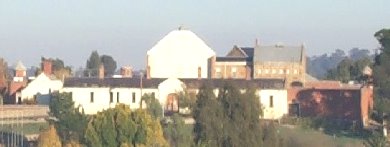
I visited the Old Castlemaine Gaols first public open day today.

The facility has a long-term lease from Mt. Alexander Council to CVGT (Central Victoria Group Training) until 2012. It is CVGT’s aim to develop the site into a hospitality training centre, an upgraded tourism venue and viable community facility.

Their long term strategic plan is about getting the ‘formular right’ and developing a sustainable precinct that will benefit the people of Castlemaine.

Although not yet open to the public, the Goal is operating as a training centre for chefs and catering.

So, what’s this got to do with chess you may ask?

As a celebration and ‘Grand Final’ of our program CHESS-SQUARED Innovations & Excellence have contracted Chess Kids to run a primary school tournament open to the 12 primary schools in our cluster on Monday October 9th.

It will be held at the Old Castlemaine Gaol.

Innovations & Excellence are supplying buses to bring students together for the tournament. Hopefully all schools will support the event, and we are hoping to get 200 students participating.

Castlemaine Chess Club convenor Harry Poulton said: “This will be the biggest event in the history of goldfields chess.”

The top four students for the day will automatically gain entry to the Chess Kids Victorian Championship held the following week in Melbourne.

Particpating schools need to enter their school and students on-line:
http://interschool.chesskids.com.au/?tournament=56

Sam Grumont will contact all schools in week 1 of term 4 to clarify any questions.

11 September, 2006

ICT confusing you?


  • Worried about wiki’s? Bamboozled by blogs? Missed DIG-TV on ABC2 last night but don’t know how to get the podcast? Interactive whiteboards not your friend yet?

    Don’t panic. You’re not alone.

    At an in-service last year in Bendigo, Tony Ryan explained the exponential rate of change, where we made a list of things that weren’t invented 5 years ago- and came up with 20 'new' items.

    Frighteningly, in the next five years there will be many, many more than 20 new ‘things’ in our lives. And in 5 years time, the above list will, dare I say it, be somewhat passé.

    Take heart however. Sit back and watch the latest technology from 1930 that set the world alight: ‘The Talkatoon’. (It's best to download, make a coffee, then view when downlaod has finished)

    And if you’re too busy to find 6.11 minutes in your life to enjoy Betty Boo, Bimbo and Koko chances are you’re probably working too hard.

    06 September, 2006

    The 'Big Day Out'


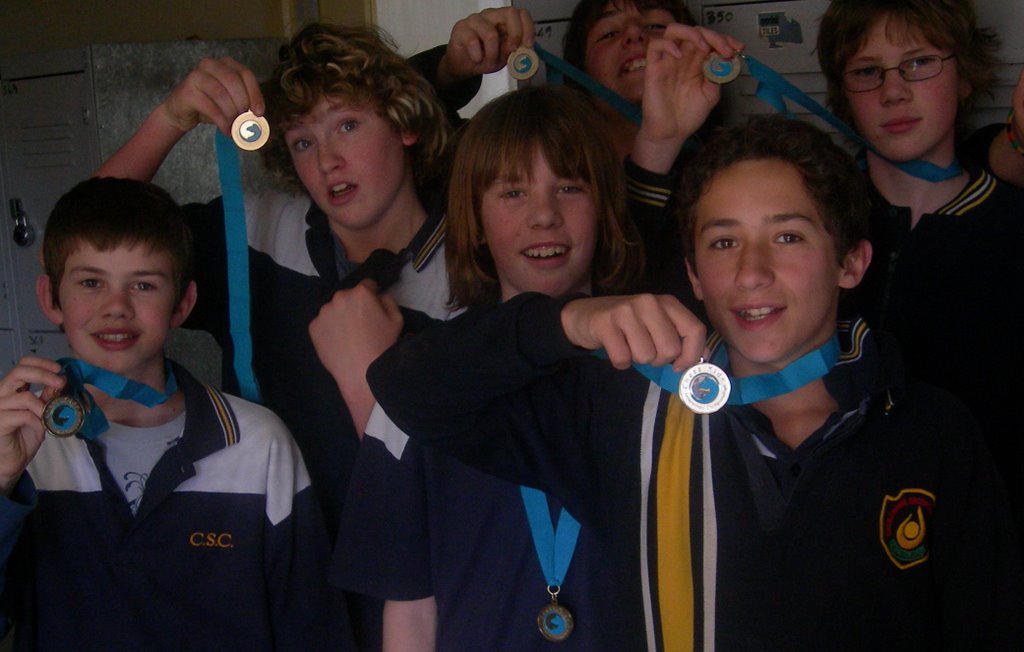
    Castlemaine Secondary College made smart moves at the recent Regional Schools Chess Tournament held at Bendigo, winning 6 of a possible 14 medals and seeing 5 students make their way through to the Victorian Schools Chess Championship.

    Of the 42 secondary students participating, 23 came from Castlemaine Secondary College.

    The result is a marvellous endorsement for our chess program- Chess-Squared- funded by Schools Innovations and Excellence, that started earlier this year.

    The program has seen teachers across 13 schools in the Mt Alexander cluster work in collaboration with tutors from the Castlemaine Chess Club and Castlemaine Community House.

    CSC teacher Mark Johansson has been a key player in the initiative. Johansson has run lunchtime tournaments honing players skills to competition standard, and has incorporated chess into his junior maths curriculum.

    Johansson has also visited primary school classrooms, teaching tactics and strategy.

    “In class students are engrossed in the game. It’s surprising how it consolidates so many maths skills.” Johansson said.

    Johansson commented on the steadily growing chess culture at CSC over the year. ‘Earlier this year, we’d run chess one lunchtime per week. Recently, it’s been running three times a week with healthy student numbers supporting the activity.’ Johansson said.

    We wish everyone well in the State Finals early next term.

    01 September, 2006

    'Poem In Your Pocket Day'


    Congratulations Sam Grumont for success of the Third Annual POEM IN YOUR POCKET Day- an initiative that encourages everyone across the 13 school cluster to carry a poem and share readings throughout the day.

    At Castlemaine Secondary College, morning staff briefing shared poetry, a whole school assembly saw principals, teachers and students share readings. My kids, from Castlemaine North Prmary School, had a visiting poet run workshops and came home overflowing with poetry.

    At CHESS-SQUARED we thought we’d get into the spirit, and came up with the work of Lewis Carroll.

    Carroll’s literary skills are legendary: he was a mathematician and chess player(sounds familiar). His work, Through The Looking Glass, follows the journey of Alice who takes on the guise of a pawn and works her way around the chess board.
    A GOOGLE search of Lewis Carroll and chess returns 120,000 repsonses including the following:

    In Through the Looking-Glass, brooks and hedges divide the countryside into one giant chessboard, Alice plays the part of a pawn. Much has been made of the implausibility of the game by chess masters, and questioned why Lewis Carroll, as a passable chess player, did not construct a more plausible game.
    ... the chess framework is full of absurdities and impossibilities, and it is unfortunate that Carroll did not display his usual dexterity by bringing the game, as a game, up to chess standard He allows the White side to make nine consecutive moves(!): he allows Alice (a white pawn) and Alice becoming a Queen, to be two separate moves: he allows the White King to be checked without either side taking any notice of the fact: he allows two Queens to castle (!): he allows the White Queen to fly from the Red Knight, when she should take it. Hardly a move has a sane purpose, from the point of view of chess.


    One can almost feel the indignation at the liberties taken.

    It’s also interesting to see the concept of ‘continuous development’ apply to both POEM IN YOUR POCKET, and CHESS-SQUARED. Both projects started small, have elements of individual passion, and continue to grow bigger each year.

    Anyway, well done Sam. And everyone who participated.

    28 August, 2006

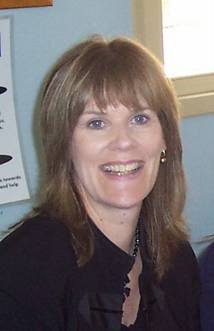
    'A time to reflect.' by Leanne Preece


    “Mrs Preece, ya wanna vs me?” challenged Conor, a delightful year seven student, while I observed a game of chess one lunchtime.

    “If you can teach me how to play first”, I replied. Conor shrugged her shoulders and walked off to find a more challenging opponent.

    And so it came to be that, once again, I found myself reflecting upon why I have never really wanted to learn to play chess before it became so popular at the Junior Campus of Castlemaine Secondary College.

    It comes down to three things:
    1. I once bought myself a terrific book on how to play the game of chess. I read the introduction,
    “Chess is a game of war. You control one army, and your opponent, the enemy, controls the other, the fate of your army depends entirely on your own skill. Most other games rely on chance – a move may be determined by the role of a die, or the turn of a card. But in chess there is no such thing as luck” …………and got no further. I have always enjoyed playing other games; my opponents often accuse me of being lucky.

    2. Before you make a move on a chess board you need to try and predict how your opponent will respond. In deciding what to play, you need to apply REASON, MEMORY, and LOGIC. Why would I want to use up my precious leisure time doing this, it sounds like hard work?

    3. I get my energy from other people (yes call me an extrovert). The though of having to sit quietly, for what seems like an age is not really my style. I prefer to work in collaboration with others, hear their ideas and have mine discussed. Everyone is so quiet when they are concentrating on their game.

    And so you see, Conor chose wisely when she sought another opponent. Is there anyone out there who would be patient enough to teach me how to play and play to WIN?

    Leanne Preece
    Junior Campus Principal - Castlemaine Secondary College

    22 August, 2006

    Chess and 'The Art of COOL'

    OLIVERS Sports Store shop window: Mostyn St. Castlemaine. Victoria

    It’s not what you do, it’s the way that you do it.
    I’m sure someone famous said something like that once.

    When Harry and I developed the Chess in Schools Program, the game had a bit of an image problem at Castlemaine Secondary College.
    It had a small band of loyal student followers. But there were detractors. Some boys felt chess threatened their sexuality, it wasn’t sporty, was uncool, and even downright nerdy.

    So, therein layed our challenge: how to make chess cool?

    We took a shotgun approach, and were prepared to try anything. We’d smile at the detractors, and ask if they’d ever played chess. We’d invite them into watch- sometimes they entered, other times they declined. And while we played, we’d talk to them: ask them about stuff- home, friends, their history, and school. Chess became a tool for connectedness: getting to know their story. And we noticed more people would come along.

    Another angle was to introduce chess at a primary school level, so when students started secondary school, chess was second nature and something they just did!
    After brilliant work by our tutoring team from Castlemaine Chess Club we’ve managed to weave fun and entertainment with deep levels of thinking, strategising, and learning. Chess is fun and kids feel they are learning and developing useful skills for life.

    Many different threads have woven together to make our fabric: developing a schools chess culture across a community.

    But then something really special happened: a piece of public relations gold!

    It wasn’t a feature article in an Education Research magazine. It wasn’t being mentioned on one of America’s biggest chess blogs. Or a Japanese school picking up our program. Or the Sydney Morning Herald article.

    Parents and students don’t dwell in these spheres. It’s not their world.

    Thanks to Winters Flat P.S our chess program got a guernsey, in the main street of town, in the shop window of the locals sports store!

    And then, we knew we’d made chess cool.

    15 August, 2006

    Our Enterprising Community


    As Phase 2 of CHESS-SQUARED draws to a close lets reflect on some of our achievements since the program started in May.

    The image above is the logo for the ‘Our Enterprising Community’ project being run from Castlemaine Secondary College.

    In May 2005, CSC received significant federal funding to develop national protocols for implementing Enterprise Education in Australian schools. The project invested heavily on staff development with Fabian Dattner, and sent a posse of teachers to Scandinavia examining best practice in Enterprise Education.

    So, what is Enterprise Education?

    In Castlemaine, it’s many things, and operates on many levels.

    In terms of CHESS-SQUARED this translates into a program that has continually evolved, developed, and at times even changed direction. We started with a vague idea- to develop a school chess culture across a community- and slowly, move by move, headed in that direction.

    Most schools run a chess program. So what, if anything, makes ours any different?

    Phase 1 saw an idea develop:
     A partnership with Castlemaine Chess Club and Innovations and Excellence
     Purchase of classroom resources
     Development of lesson plans and resource material.

    Phase 2 saw the launch of the project into 13 schools across the cluster in May, and since then:
     Partnership and mentor support from Latrobe University
     Development of a weblog (Blog) as a communication tool
     Press coverage in Education Times, Midland Express, Sydney Morning Herald
     2,500 feature article in ACER publication Teacher magazine
     Presented at a Simmer conference on using ICT to promote maths, science, and technology in rural school communties
     Featured on Susan Polgars blog in America
     Funding support from School Focused Youth Service (SFYS)
     Partnership with Castlemaine Community House
     Commitment for further support from Innovations and Excellence
     A teacher from Japan visiting the program, taking our model and resources to use in her school in Japan
     Local shops displaying the program in their shop windows
     Enecdotal data from teachers, and empirical data from observation schedules
     An estimated 260 students exposed to regular chess tutoring across Mt Alexander cluster

    Enterprise Education is about fostering the resources of our community to support student learning. It's about thinking laterally. And seizing opportunities.
    If developing enterprising skills in students involves attributes of thinking, planning, impulse control, and using strategy then surely we have embarked on that journey.

    Phase3 of CHESS-SQUARED starts tomorrow.

    31 July, 2006

    'The Seduction of Learning' by Sam Grumont (I & E Cluster Co-ordinator)


    Hi chess aficionados,
    I wandered into an interesting site which talks about the arousal the competing in the game can give to the brain - cognitive arousal is the buzz word to give you some afflatus:

    'Is Sudoku seductive? Is chess sexy? Is crafting code a turn-on? To our brains, absolutely. But while most of us don't use the word "seductive" in non-sexual contexts, good game designers do. They know what turns your brain on, and they're not afraid to use it. They're experts at the art of "cognitive arousal", and if we're trying to design better experiences for our users, we should be too.

    I'm not talking about using sex to arouse your brain. I'm talking about the kind of "experiential pleasure" that comes from solving a puzzle, overcoming a challenge, exploring new territory, becoming swept up in a narrative, interacting with others in a social framework, and discovering something new about yourself. I'm talking about things that engage the brain in a way that Gregory Bateson describes in The Ecology of Mind, discussing games:

    "... they are important emotions that we feel and go through and enjoy and find in some mysterious ways to enlarge our spirit."'

    Want more then try
    http://headrush.typepad.com/creating_passionate_users

    22 July, 2006

    The GENDER Puzzle.


    Chess and gender always gets a heated response.
    For those who don’t know chess has, historically, been dominated by males. And the obvious question is WHY?
    A GOOGLE Search on the topic will return 2,600,000 responses- some which I’ve included below.
    Without getting embroiled in gender warfare, I’ve noticed some interesting observations- completely untested- in my own classes.
    Last year, I had a predominately male yr9 maths methods class (16males, 4 females) where the boys would BEG to have chess games/tournaments during class time. They would salivate and engage in battlemode of the highest order.
    Of the 4 girls, one was a good player, one had never played, and two were indifferent. When they played together (chose not to play with the boys!) they had a co-operative approach, naturally sharing strategies and working much less competitively.
    One girl wasn’t the slightest bit interested in playing and continued with maths ‘from the book’. I asked her why girls seemed less interested in playing chess.
    And, her response was a classic!
    She shrugged her shoulders: “Girls have got better things to do with their time.”
    Touche!
    This is interesting when we compare attitudes with my yr7 class: boys and girls seem equally keen to play chess. There doesn’t seem any obvious gender difference and these are the comments we are hearing from primary school sessions.
    The implications, and questions from this are interesting.-
    1) what happens, hormonally with the onset of puberty, that effects interest in chess, and perhaps other areas of maths development?
    2) if chess has the benefits we think, it must be important to introduce it as early as possible.
    3) are girls being disadvantaged if they haven’t been introduced to chess pre-pubescant?
    4) is there any correlation between girls who complete VCE Maths, and those who have been exposed to chess.
    There are many aspects to this fascinating topic. If you have any anecdotes, theories, or ideas, please let us know about them in our comments section.
    Before you find the right answers, you need to ask the right questions.

    05 July, 2006

    Meeting the tutors(2): Guiding Guildford with Ron Moore

    (Ron Moore with students at Guildford Primary School)

    Hi
    My name is Ron Moore. I’m engaged as a tutor in the ‘Chess in Schools’ Program. It is my privilege to introduce this most fascinating of games to students.
    I first started playing chess when I was at primary school and have been hooked ever since.
    My experience in learning to play better chess was a long process. I ‘pushed wood’ for a long time, suffered many thrashings and only gradually became aware of the strategies, subtleties and complexities of the game.
    As I began to play a better game I came to enjoy chess even more.
    Fellow workers and family recognize me as someone who is very process orientated. Is this an outcome of my chess playing? Possibly! There are probably a number of skills that every player derives from playing chess.
    The purpose of the ‘Chess in Schools’ is to develop cognitive skills, but I believe, in teaching school children to play a purposeful game of chess, much more can be learned.
    And we should never forget that chess is great fun and can be enjoyed at any number of levels by both novices and experienced players.

    26 June, 2006

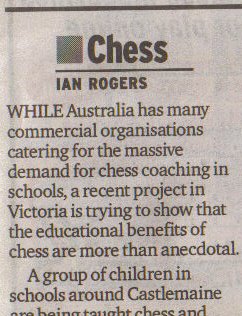
    SYDNEY: The Sun-Herald 25/6/06 p85


    The article goes on to say:

    A group of children in schools around Castlemaine are being taught chess and encouraged to provide brief comments on their thought process which produce moves.

    Not only are chess-playing children being compared to their non-playing peers in areas such as numeracy, but the effect on patience and self-control within the chess-playing group might also be measured.

    One observation a researcher has made in the early stages of the project is that many children are keen to play chess but regard instruction as redundant- an attitude natural for todays video game users who aquire skill solely by playing.

    This attitude can only be overcome once the connection between chess success and useful advice is established- a link which will hopefully be carried over to other school subjects.

    The Australian Council for Educational Research this month published an article on the project, the ambitions of which appear unlimited given the piece's sub-title 'Chess Generates Genius'.

    Regardless of hyperbole, the project is certainly worthwhile since if chess is shown to be an activity which kids are happy to try and which even indirectly improves numeracy, it could become a useful tool in schools' arsenals
    .

    12 June, 2006

    ACER interest


    ACER (Australian Council for Educational Research) showed some interest in our project and wanted an article. 2500 words later a nice little article features in their latest edition.
    The full article outlines HOW the 'Generating Genius' principles were incorporated into program development.
    If you would like a FREE copy of the magazine, add a comment to our blog and tell us who you are.
    How easy is that?

    If you want to read an on-line shorter version visit: http://www.acer.edu.au/publications/acerpress/teachermagazine
    Click: Current issue > Maths,Science,Environment
    And there it is!

    05 June, 2006

    Susan Polgar sends her regards.


    Hello everyone! I was just told about this blog from Steve Carroll.

    Australia is one of my all time favorite countries. I have so many wonderful memories there.

    I wish you ALL the best and please feel free to visit my blog www.susanpolgar.blogspot.com. I will also put up a notice about your blog shortly.

    Best wishes,
    Susan Polgar
    www.SusanPolgar.blogspot.com
    www.SusanPolgar.com
    www.PolgarChess.com

    For those who dont know, Susan Polgar is one of the worlds biggest names in chess, and the first women to 'hold her own' against elite male chess players in the world. (Hope I got that right Susan!)
    Her blogs are fascinating. Some of her passions are bringing chess into the lives of youth, and introducing and promoting chess to girls.
    She's a champion of chess, and a champion of youth!Her efforts to promote chess to young people are truly inspiring. If you get a chance visit her sites listed above.
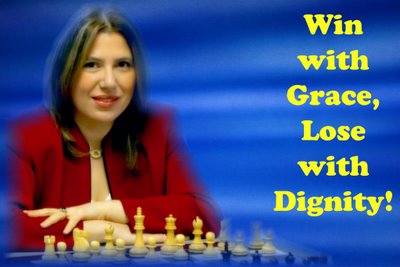
    I particularly like her motto when teaching children: 'Win with grace, lose with dignity.'
    I feel a discussion about chess and gender brewing! Stay tuned.
    regards
    Steve Carroll
    p.s
    And true to her word, our humble little blog is now listed on Susans Blog:
    http://susanpolgar.blogspot.com/
    http://susanpolgar.blogspot.com/2006/06/new-blog-from-down-under.html